
Commercial Water Treatment Salt is the lifeblood of any facility that relies on soft water for its boilers, cooling towers, or laundry services. At SAMA UNITED, one of the most frequent questions we receive from facility managers is: “Should I buy granular salt or salt pellets?” It seems like a simple choice, but as an expert who has spent years troubleshooting water systems with SAMAUNITED, I can tell you that the wrong choice can lead to clogged valves, inefficient regeneration, and unexpected maintenance costs.
In this guide, I want to share the technical and practical insights we’ve gathered at SAMA UNITED. We don’t just supply salt; we supply the knowledge that keeps your operations running at peak efficiency. Let’s break down the differences between these two common salt types so you can make an informed decision for your business.
Commercial Water Treatment Salt: Choosing Between Granular and Salt Pellets for Your Facility
The Basics of Granular Salt: Fast and Functional
Granular salt is essentially a coarse, high-purity rock salt that has been crushed and screened to a specific size. Many of our clients at SAMA UNITED prefer granular salt for its simplicity and initial cost-effectiveness.
When is Granular Salt the Right Choice?
Granular salt is highly effective in systems where the water turnover is constant and high. Because the grains are smaller than pellets, they have more surface area relative to their volume, which allows them to dissolve very quickly. If your facility has a rapid regeneration cycle, granular Commercial Water Treatment Salt can provide the quick brine saturation you need.
However, granular salt requires a bit more “babysitting.” Because the grains are small, they can sometimes pack together tightly at the bottom of the brine tank, leading to a phenomenon we call “mushing.”
The Science of Salt Pellets: Engineered for Consistency
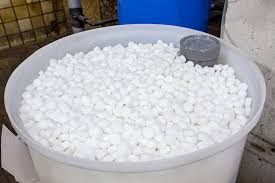
On the other side of the spectrum, we have salt pellets. These are created by taking high-purity evaporated salt and mechanically pressing it into uniform, pillow-shaped pieces. At SAMA UNITED, we often recommend pellets for high-end industrial systems and facilities that want a “set it and forget it” solution.
The Main Advantages of Pellets:
-
Preventing Salt Bridging: A “salt bridge” is a hard crust that forms across the brine tank, creating an empty space underneath. When this happens, your water doesn’t touch the salt, and your softener fails to regenerate. Pellets are shaped to prevent this by allowing air and water to circulate freely between them.
-
No Mushing: Because pellets are compacted under high pressure, they maintain their shape until they are almost entirely dissolved. This keeps your brine tank clean and prevents the sludge that can clog your intake valves.
Comparing Efficiency: Performance Under Pressure
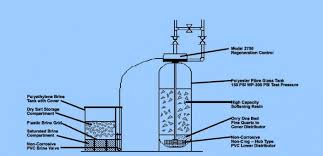
When choosing your Commercial Water Treatment Salt, you have to look at how your ion-exchange system actually performs. At SAMA UNITED, we evaluate efficiency based on “Brine Consistency.”
-
Granular Performance: If your tank is well-maintained, granular salt provides a very strong brine very quickly. It’s excellent for smaller, high-frequency systems.
-
Pellet Performance: Pellets provide a slow, steady release of sodium. This is ideal for large-scale industrial softeners that handle thousands of gallons of water. The uniform shape of the pellets from SAMAUNITED ensures that every regeneration cycle is identical to the last, providing a level of predictability that engineers love.
Commercial Water Treatment Salt: Choosing Between Granular and Salt Pellets for Your Facility
The Maintenance Factor: Which One Saves You Time?
In my years on the field with SAMA UNITED, I’ve noticed that labor costs are often ignored when buying salt. Granular salt is usually cheaper per ton, but if your maintenance team has to spend two hours every month breaking up salt bridges or cleaning out the “mush” from the bottom of a tank, that “cheap” salt just became very expensive.
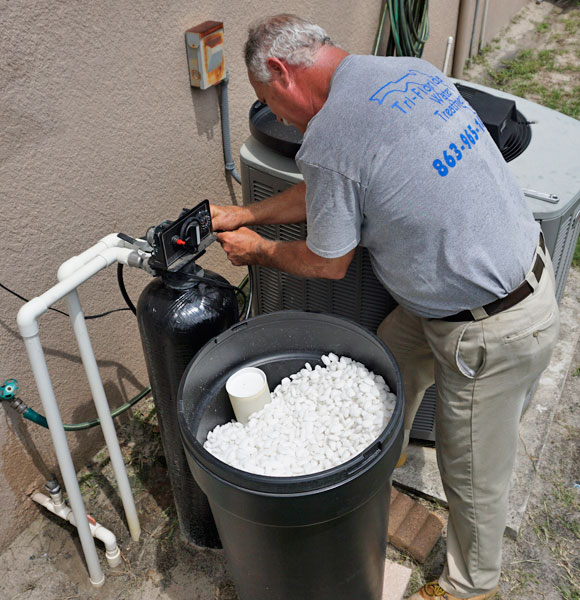
Salt Pellets are generally the winner when it comes to low maintenance. Because they dissolve so cleanly, the “brine well” and the bottom of the tank stay free of debris for much longer. For facilities like hospitals or data centers where downtime is not an option, the reliability of pellets is worth the slight premium in price.
Purity Standards: The Sama United Difference
Regardless of whether you choose granular or pellets, the most important factor is the purity of the Commercial Water Treatment Salt. At SAMA UNITED, we ensure that our salts are processed to reach near-perfect NaCl levels.
Why does this matter? If your salt contains even 1% of insoluble material (like dirt or sand), that material will eventually end up in your resin bed. Resin is the most expensive part of your softener. Over time, these impurities “foul” the resin, making it less effective at removing calcium and magnesium. By sourcing your salt from SAMAUNITED, you are protecting your resin and extending the life of your entire system.
Making the Decision: A Simple Checklist
To help our clients, the team at SAMA UNITED developed this quick checklist to help you choose:
-
System Type: Is it a high-capacity industrial softener? Go with Pellets. Is it a smaller, frequent-cycle system? Granular might be better.
-
Labor Availability: Do you have a dedicated team to check the brine tanks daily? Granular is fine. Do you need a low-maintenance solution? Choose Pellets.
-
Storage Conditions: Is your salt stored in a high-humidity area? Pellets resist clumping in humidity better than granular salt.
-
Budget Strategy: Are you looking for the lowest upfront cost (Granular) or the lowest total cost of ownership (Pellets)?
Commercial Water Treatment Salt: Choosing Between Granular and Salt Pellets for Your Facility
Why Partner with Sama United for Your Salt Supply?
At SAMA UNITED, we understand that every facility is different. We don’t believe in a “one size fits all” approach to Commercial Water Treatment Salt. When you work with us, you aren’t just getting a delivery; you’re getting a partner who understands the logistics and the chemistry of your water.
-
Reliable Bulk Delivery: We have the infrastructure to deliver large quantities of both granular and pellets, ensuring your silos never run dry.
-
Quality Assurance: Every batch of salt from SAMAUNITED is tested to meet strict industrial standards.
-
Expert Guidance: Our team can help you analyze your water hardness and system demand to recommend the most efficient salt type for your specific needs.
Conclusion: Pure Performance for Your Business
In conclusion, the choice between granular and salt pellets comes down to balancing your upfront budget with your long-term maintenance goals. Both are excellent tools in the fight against hard water, provided they are of high purity.
At SAMA UNITED, our goal is to make your water treatment as seamless as possible. Whether you decide that the fast-acting granular salt fits your budget, or the high-efficiency pellets fit your maintenance strategy, we are here to provide the highest quality minerals and the most reliable service in the industry.
Ready to optimize your water treatment system?
Contact the experts at SAMA UNITED today. Let’s discuss your facility’s requirements and set up a Commercial Water Treatment Salt supply plan that saves you money and protects your equipment for years to come. At SAMAUNITED, your operational success is our priority.